FIPP Insider Baltics: The Value of Print
13 November, 2026
Seminars
Lūdzu atjauniniet savu pārlūkprogrammu
Jūsu Tīmekļa pārlūks nespēj pilnvērtīgi attēlot šo lapu, jo šī lapa ir būvēta balstoties uz moderniem Tīmekļa standartiem. Lai apskatītu šo lapu, aicinām Jūs izvēlēties kādu no modernajiem Tīmekļa pārlūkiem, kas pieejami zemāk.
Bezmaksas pārlūkprogrammas - visas pārlūkprogrammas nodrošina vienādas pamatfunkcijas un ir viegli lietojamas. Izvēlieties, kuru pārlūkprogrammu vēlaties lejupielādēt:

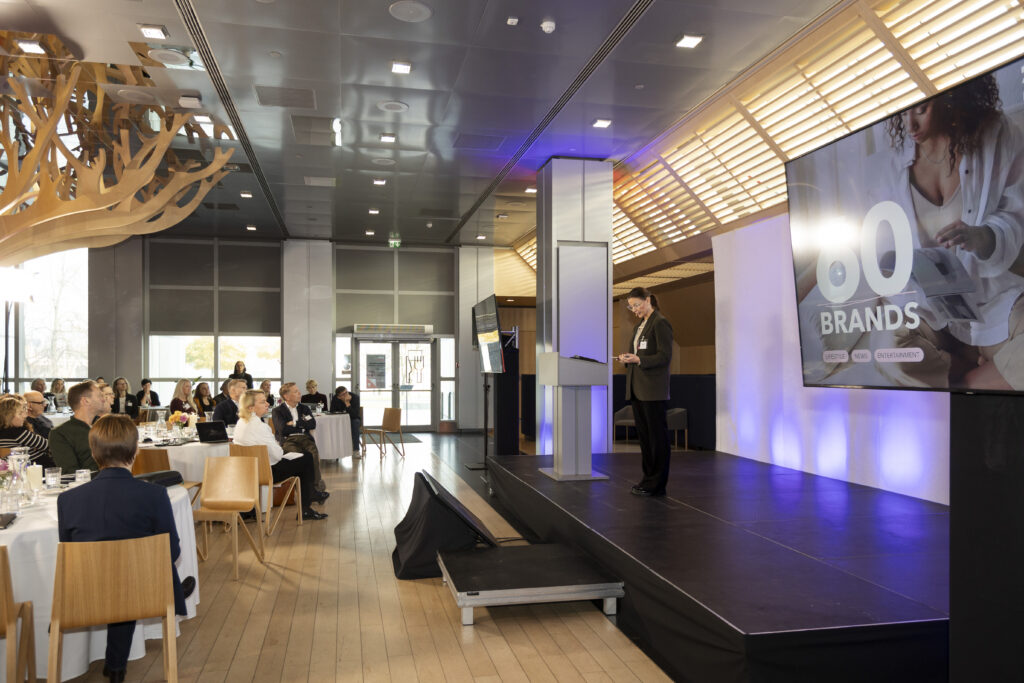
Industry professionals addressed these and other questions at the international seminar FIPP Insider Baltics: The Value of Print, co-organised by Poligrāfijas grupa Mūkusala and FIPP, which took place at the ‘Klīversala’ restaurant in the National Library of Latvia.
At the seminar, publishers, marketing agencies, and printing professionals emphasised the value of print and shared their knowledge and experience on how to fully leverage the potential of print media. They discussed the advantages of print advertising and how publishers can integrate it into innovative business models. Experts also explained how knowledge of psychology and strategic design can capture the reader’s attention.
Kristina Papule, Chief Bibliographer at the Periodicals Department at the National Library of Latvia, opened the seminar and outlined the historical context, while Alastair Lewis, Chief Commercial Officer at WAN-IFRA, introduced the latest trends in publishing. The morning session concluded with Maria Dabelsteen Jensen, Senior Vice President at Aller Media, sharing an inspiring story about how she managed to bring a discontinued magazine back to readers.
Antti Makkonen, Sales Director for Graphic Papers at Sappi Europe; Andy Cowles, editorial design and branding consultant at Cowles Media; and Jurģis Šķilters, Professor and Chair, Lab for Perceptual and Cognitive Systems, Faculty of Science and Technology at the University of Latvia, revealed how the choice of paper, design, and even colour influences magazines sales. Insights into publishers’ real-world experiences with diversifying print media revenue were shared during a panel discussion featuring Lulu Skantze, Publisher and Creative Director of Storytime magazine, and Aija Šmidre, Chair of the Board at the publishing house Rīgas Viļņi. The discussion was moderated by Alastair Lewis.
In the final segment of the day, Lulu Skantze, Publisher and Creative Director of the children’s magazine Storytime, and Amanda Wigginton, commercial strategy and audience insight specialist, shared examples and data demonstrating that a magazine can serve as the foundation for digital platforms that achieve global success. At the end of the event, attendees had the opportunity to take a guided tour of the National Library of Latvia and learn about the first Latvian magazines.

Kristina Papule, Chief Bibliographer at the Periodicals Department at the National Library of Latvia, ‘Demand It Everywhere! Advertising in Latvian Newspapers from the 19th Century to the Present Day’, offering an insightful account of how the genre of advertising has developed and changed over time. It became clear that advertising reveals a great deal about the era in which it was published.
As early as 1822, in the pages of Latviešu Avīzes, published in Jelgava, a Russian man named Simon placed a job advertisement offering to saw logs. He claimed that he did quality work and did not charge much. Gradually, classified ads became a regular feature of newspapers. Initially, they were placed on the news pages, but after World War I, there was a real boom in publications dedicated to advertising. The first publications of this kind were issued by local councils. They included both up-to-date information on services available in the area and recommendations on where to purchase various items.
Through classified ads, people sought both missing relatives and jobs after World War I. Interestingly, the ads were printed in all local languages at the same time. Many people placed ads in an attempt to sell their property and generate income. At that time, the ads were not categorised, so finding the information one needed required a special skill. Similarly, newspapers featuring personal ads were also very popular during the interwar period. As the researcher points out, these diverse classified ads offer a complete portrait of postwar society.
Papule described the period between 1941 and 1991 as a time of ‘advertising without advertising’. There is a perception that there was no advertising, but in the early 1970s, as a wider range of consumer goods became available, advertising publications emerged, such as the advertising supplement of Rīgas Balss. In the 1980s, thanks to advances in printing technology, advertisements became increasingly colourful. Soon, cooperative publications also appeared, in which people could offer their services and goods. However, starting in 1991, a wide range of publications began to appear.

Alastair Lewis, Chief Commercial Officer at WAN-IFRA, presented international magazine trends and findings from the FIPP World Congress, which took place in Madrid this past October.
Alastair began his presentation by looking back to about four years ago, when uncertainty reigned among publishers, and many companies were forced to merge or pivot toward digital platform businesses. It seemed that this was the future—striving for a larger scale that print publications could no longer provide. A critical turning point was the emergence of widely accessible artificial intelligence tools, which forced publishers to rethink their business models and understand the true value of their work.
Reflecting on the discussions at the conference, Alastair highlighted four main themes — trust, focus, the impact of artificial intelligence, and resilience. Of course, all these themes are interconnected; for example, trust is particularly crucial amid the abundance of unverified content generated by artificial intelligence. In such circumstances, trust is what gives print media its unique value. In turn, trustworthy content has the power to bring a community together — a community without which a long-lasting publication cannot survive.
Another insight shared at the conference was that, in the age of social media, magazines no longer serve as mass media, but they can still add value by deepening their connection with readers and adopting a more focused approach to content. It turns out that a broad audience is often less willing to pay for content. Therefore, it is important to create specialised content, which may have a narrower target audience but one that is much more willing to pay for niche material.
Alastair acknowledged that there is currently no conference where the impact of artificial intelligence on the industry isn’t discussed. This can manifest in various ways, but one example is the adaptation of content published in the digital environment for artificial intelligence agents. In other words, we must now think not only about making content understandable and accessible to readers, but also to AI agents, which then selectively pass it on to people. At the same time, publishers must also maintain a sense of stability — while adapting to the demands of the times, developing their business in the digital environment, and organising events, they must remember that the core is always the print magazine. Alastair’s presentation was perfectly complemented by the next speaker, who shared an inspiring story about how to breathe new life into a magazine.

Maria Dabelsteen Jensen is Senior Vice President at Aller Media. In her presentation, ‘Against the Trend: Why We Bet on Print — and Won’, she explained how she managed to revive a magazine that had been discontinued. While most publishers are shifting their investments from print to digital, she decided to do the opposite and invest in the magazine.
Aller Media is a Copenhagen-based family-owned company, with editorial offices in Stockholm, Oslo, and Helsinki. Each month, its 60 different print publications reach 50 million people across the Nordic region. The magazine that Maria focused on in her presentation is Femina. For 150 years, it was a popular weekly magazine among women, but it ceased publication because the publishers did not consider it profitable enough. However, Maria recognised the value of a high-quality women’s magazine, and she knew that reaching a female audience was also important to advertisers.
In order to resume publication of the magazine, it was important to link the print edition with the digital platform, so everyone who purchased the magazine was also given access to the digital version. The print edition, which came out once a month, offered a special experience, while new content was available daily in the digital environment. The first newly released issue sold out, and additional copies had to be printed because this inspiring story received widespread coverage in other media, on the radio, and on television.
Comparing the success of the former weekly and monthly magazines, Maria reveals that the weekly magazine used to be purchased by 5,000 to 6,000 readers per week, while the monthly magazine is now bought by about 22,000 readers. Although the number of copies sold is similar, distribution costs have decreased, and the readership is much more loyal. Costs are also being optimised in content creation. The magazine is dedicated to crafts, cooking, home, and fashion, but the publishers choose not to hold photo shoots with professional models because it is expensive. As Maria says, she wants to see real women in her magazine. This reflects the fact that listening to readers and taking a realistic approach can be the key to a publisher’s success.
Antti Makkonen, Sales Director for Graphic Paper at Sappi Europe, emphasised in his presentation the importance of cross-industry collaboration in promoting the value of print. In discussions about print media, people often say, ‘It’s expensive.’ That is why Antti points out that we need to change the way we talk about print. ‘Expensive’ is a superficial excuse. We need to place greater emphasis on the value of print, which exists only as long as there is an industry to produce it.
When it comes to the advertising industry, data shows that combining print and digital media can yield a return on investment that is up to 25% higher. A campaign’s effectiveness is also determined by a precisely defined audience, and print media makes this possible. Advertising that reaches the right audience can increase the return on investment by 30% while cutting customer acquisition costs in half.
Antti acknowledges that every paper seller has to answer tough questions about sustainability and the raw material used to make paper — wood. At the same time, he points out that paper packaging seems like a greener choice compared to plastic. So why is using paper packaging considered acceptable, but printing on it isn’t? Undeniably, forests are of immense value and must be managed sustainably. Recycled paper is already widely used today. Unfortunately, paper can only be recycled a few times, and it becomes more brittle with each cycle, which is why recycled paper is often made from a mixture of new and previously used fibres. At the same time, we must not forget that digital media also consumes resources. In contrast, the energy costs of printed products are one-time expenses; they do not require batteries or electricity.

Andy Cowles, editorial design and branding consultant at Cowles Media, used specific examples in his presentation to explain how a magazine cover helps sell the publication. Andy specialises in redesigning and revitalising media brands. He emphasised that a magazine cover must not only be visually appealing but also convey a clear message — in other words, it must be able to distinguish itself from the vast array of other publications.
Readers decide within just a few seconds whether to buy a magazine or not, so the cover must clearly and simply convey the brand’s story. At the same time, the cover serves as an advertisement for the brand — it’s displayed on magazine racks and in store windows. Ultimately, it is also the brand’s legacy — what will remain in the pages of history.
When a reader chooses to subscribe to a magazine, they are placing their trust in the brand to live up to their expectations. It’s a story about shared values. However, it’s also important to note that a magazine is, in a way, a fashion statement. To engage the reader and allow them to identify with the specific media brand, the reader must be placed at the center. In other words, the reader must be made the hero. To establish this connection, the cover design must engage the reader. For example, the cover copy should be empathetic and help the reader understand the image and the magazine’s message, Andy emphasized.

Andy’s presentation was perfectly complemented by a talk from Jurģis Šķilters, a professor of cognitive science at the Faculty of Natural Sciences and Technology at the University of Latvia and the Chair of the Perception and Cognitive Systems Laboratory, on the connections between colour and emotion.
Research has shown that colours are linked to emotions. Colours improve attention and make us more alert. We form quick and automatic reactions to colours, and these reactions are further influenced by our age group. Interestingly, the relationship between colours and emotions varies across different age groups; for example, people aged 20 to 40 tend to prefer black-and-white colour schemes, while those aged 40 to 60 and older prefer warm tones.
There is much discussion about the connection between colours and their associative meanings, and indeed, these associations are generally quite well-defined. There are stereotypes that the meanings of colours are culture-specific, but research confirms that, in reality, these differences are minor.
It is not only the hue of a colour that matters, but also its lightness and saturation. By adjusting these aspects, a single colour can evoke both very pleasant and very unpleasant emotions. Similarly, in print, we perceive colour in the context of typefaces. Here, too, the purpose of the text is important. Rounded fonts will appear more pleasant, while angular, large fonts will appear ‘loud’. The researcher had to acknowledge that, unfortunately, there are no ideal colour combinations, but there are combinations that can be customised for a specific goal and adapted for a specific purpose, thereby increasing the likelihood of engaging the intended reader.

Lulu Skantze is the Publisher and Creative Director of Storytime magazine. In her presentation, ‘Content in Motion’, she shared her experience on how to add value to magazines on a global scale. In other words, a magazine is just the beginning of a story.
Publishing children’s magazines and fostering a love of reading in childhood is extremely important, because that is how we shape the audience of the future, Lulu believes. Magazines are portals to the imagination; they are something between a book and a toy, allowing children to learn through play — for example, by cutting out pictures.
A common problem in the children’s magazine industry is plastic — every issue is packaged in a plastic bag containing a plastic toy. When the first issue of Storytime was published in September 2014, most people believed that a children’s magazine without an included toy would be impossible to sell. However, from the very beginning, Storytime goal was to focus on content and eliminate plastic packaging. It contains no advertisements, so the content can be adapted for schools and English-language curricula. Twelve years later, 144 issues have been published; the magazine operates in five countries and is available in more than 60 countries. It has issued more than 20 licences.
Previously, Lulu worked with Disney and Mattel, where she saw how these brands license content. From the very beginning, she knew that Storytime would do the same. This requires careful groundwork, precise archiving of content, and adaptation to different reading levels; it also involved consulting with lawyers and establishing partnerships. As Lulu emphasised, the key to international growth is original, high-quality, adaptable content.

Amanda Wigginton is a commercial strategy and audience insight specialist at PPA (Professional Publishers Association) Magnetic. In her presentation, ‘Context, Community, and Conversion: redefining print for today’, she emphasised that trusted media brands possess superpowers that are underappreciated and underutilised.
Amanda began her presentation by noting that there is no competition between print and digital media; on the contrary, they complement each other, and their interaction fosters trust. She supported this with the results of an extensive study conducted by the association. The advantages of print media lie in the safe environment it creates and the conscious focus the reader devotes to it. This is particularly important for advertisers, as it ensures that ads are published in an appropriate environment.
Print media is one of the last places to escape the digital environment and where human-created content, free from algorithms, is available. This means that a person who opens the pages of a magazine has most likely done so intentionally and in a good mood, which in turn means that the advertisement reaches a positive potential customer. As several speakers have already mentioned, a magazine can shape a reader’s identity and sense of belonging to a community. It is precisely this emotional connection that is a magazine’s greatest value.

Although each of the speakers focused specifically on their own professional expertise — whether it was publishing, design, or research on human perception — a common theme ran through all the presentations: a printed publication has a value that no digital tool can replace. We had the opportunity to see this for ourselves during the guided tours of the National Library of Latvia at the end of the day. Indeed, nothing brings such peace as being surrounded by books, newspapers, and magazines.


Original article: Renāte Berga (translated)
Photos: Ieva Salmane
Visualization of the event: Amanda Pētersone